
The conversation around men’s mental health often struggles because many men were never taught how to talk about their feelings in the first place.
The conversation is often shut down before it even starts. This lack of an emotional vocabulary makes it hard to recognize when a problem exists, let alone seek help for it.
It’s a critical factor in understanding why men’s mental health is so often neglected.

Significantly different from non-Hispanic black and Hispanic men. SOURCE: CDC/NCHS, National Health Interview Survey
Recent data paints a clear picture of this silent struggle:
- A global crisis:
The World Health Organization reports that men are more than twice as likely to die by suicide than women.
- The gender gap in seeking help:
In the U.S., only 17.8% of men aged 18-44 received mental health treatment in a recent year, compared to 28.6% of women in the same age group.
- A local view:
In Nigeria, men account for 80% of all suicides, and a staggering 37% of Nigerian men admit to hiding their struggles even from their partners.
Why do these numbers exist? Why is it so hard for men to speak up?
This guide will explore the reasons behind this, challenge old ideas about strength, and provide practical, research-backed steps for you to take control of your mental well-being.
This is your first step on a powerful wellness journey.
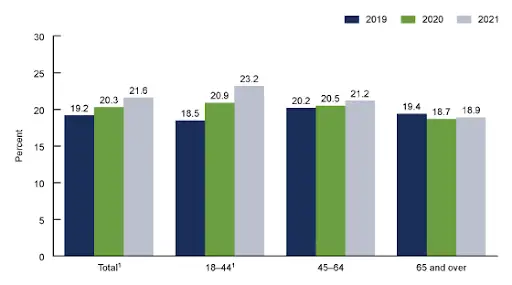
Percentage of adults aged 18 and over who had received any treatment for their mental health in the past 12 months, by age group and year: United States, 2019–2021
GET THE MENVIVE WHOLE BLUEPRINT HERE: OUR SOLUTION TO MEN’S MENTAL HEALTH
Why Men’s Mental Health Is So Often Overlooked
Understanding a problem is the first step to fixing it. For men’s mental health, the reasons it’s often overlooked are not simple.
They come from a mix of social messages and personal habits that have been around for a long time.
These factors can create a cycle where men feel pressure to handle everything on their own, often without even realizing they have a problem.
- Trying to be Tough
For many men, the message from a young age has been to be strong, stoic, and self-reliant.
This traditional idea of masculinity, often called the “self-sufficiency syndrome,” teaches that showing emotion is a sign of weakness.
- Silence is strength: This belief pushes men to keep quiet about their struggles, thinking they must solve problems alone.
- Hiding struggles: A survey found that 37% of Nigerian men admit to hiding their mental health struggles, even from their intimate partners.
- The cost of silence: This emotional bottling-up can lead to a breakdown in dealing with life stresses, such as financial problems or relationship issues, often leading to a crisis.
- The Problem of Emotional Literacy
The conversation around men’s mental health often struggles because many men were never taught how to talk about their feelings in the first place.
This lack of an emotional vocabulary makes it hard to recognize when a problem exists, let alone seek help for it.
- Unaware of emotions:
Some men are just not even fully aware of the emotions they’re having, which makes it difficult to know they need support.
- Different symptoms:
For some men, depression doesn’t look like sadness; it can show up as irritability, sudden anger, or an increase in risky behavior.
- Harmful coping:
Instead of talking, men are more likely to use unhelpful coping methods like excessive drinking, frequent drug use, or throwing themselves into work.

Why Men Don’t Seek Help
Even when men know they need help, there are powerful barriers that can stop them from reaching out.
These barriers are often rooted in social perceptions and a fear of judgment.
- Fear of being a burden:
A significant number of men don’t seek help because they don’t want to be a burden on others.
- Embarrassment and stigma:
Many men feel too embarrassed to speak about their mental health, fearing the negative stigma around it.
- Low professional engagement:
In the UK, only 36% of referrals to talking therapy services are for men. Alarmingly, 40% of men say they would need to have thoughts of suicide or self-harm before they would get professional help.
BOOK A THERAPY SESSION WITH ONE OF OUR EXPERTS TODAY!

Time to Take Action: How to Address Men’s Mental Health Issues
Breaking the cycle of silence takes courage, but it’s a journey worth taking.
It’s about moving from silent struggle to a life of peace and purpose.
This isn’t just a list of tasks; it’s a blueprint for a stronger you, and your first direct answer to why men’s mental health is an issue you need to take seriously.
1. Tidy Your Space, Calm Your Mind
Our environment impacts our inner state. Taking control of a small, physical space creates a powerful sense of order and peace that can calm a chaotic mind.
- Step 1: Pick one small, cluttered area you see every day.
- Step 2: Give yourself just 15 minutes to clean it.
- Step 3: Tidy, organize, and wipe down that space. When you finish, look at the clean space you created.
2. One Hour, No Screens
This strategy is about actively protecting your mind from the constant overstimulation of the digital world.
- Step 1: Choose a consistent, non-negotiable 60-minute window each day.
- Step 2: Put your phone in another room. Turn off notifications.
- Step 3: Do one non-digital thing. Read a book, listen to music, or simply sit in silence.
3. Write It Out
This strategy moves beyond simply thinking about gratitude and turns it into a physical release. It’s for men who find it hard to talk, but can express through action.
- Step 1: Get a pen and a single piece of paper. This is just for you.
- Step 2: Spend a few minutes writing or drawing anything you’re grateful for, big or small.
- Step 3: Look at the page. You’ve created a physical document of the good things in your life.
4. Do Less to Be More
This is a mental health strategy based on subtraction, not addition. In a world that tells men to do more, this practice gives you permission to do less.
- Step 1: At the start of your day, look at your to-do list.
- Step 2: Consciously choose one non-essential task and cross it off. That’s it.
- Step 3: Use the mental energy you saved for something else—a moment of rest or a deeper breath.
5. Act for the Future
This strategy reframes seeking help not as an act of weakness, but as an act of legacy-building.
- Step 1: Think about the young men in your life. Ask yourself, “What example of a healthy, strong man do I want to leave for them?”
- Step 2: The audience for this “conversation” is internal. It’s for you.
- Step 3: When you feel a struggle, ask yourself: “What would the next generation need me to do?”
—————————————————————-
Where Menvive Comes In….
These steps are powerful, but the journey is often easier and more effective with the right tools and a supportive community. This is exactly where Menvive provides a solution.
Our Wholeness Blueprint offers a framework and brotherhood designed to help you implement these very steps, providing the resources and a judgment-free space to redefine your strength and build a truly resilient life.

End Note…
You’ve seen how powerful simple, intentional acts can be. Each of these steps—from a 15-minute clean to a single hour without screens—is a deliberate choice to prioritize yourself.
They are not one-off tasks; they are bricks you use to build a new foundation of inner peace.
This is the true meaning of strength: taking proactive control of your well-being, one small, powerful step at a time.
CONTINUE WITH US: CHECK OUR RELATED ARTICLES
This is just the beginning. True well-being is about building a holistic life. To continue your journey, explore some of our other guides.